For King and Kaiser | Paperback
- Royal Mail delivery from £2.45. Despatched within 2 working days.
Exclusive to this shop.
Couldn't load pickup availability
Not every enemy wears a uniform.
August 1914. England has declared war, and in Hackney, anti-German feeling is running high.
When PC Matthew Stannard finds a German woman hiding in a van after an angry mob attack, he takes her in for questioning. Seemingly innocent of any wrongdoing, she is released.
But as he learns more about her, Matthew believes the woman should be considered a threat to England's security, and reports his fears to Detective Sergeant Maudsley of Special Branch, hoping he’ll take action.
But Maudsley has no time for a young constable’s suspicions. He’s under pressure to catch the head of a German spy network who is planning an attack that could cost thousands of lives.
If Matthew wants to stop this woman before she can strike, he’ll have to act alone.
Read An Excerpt
Chapter One
Chapter One
Tuesday, 4th August 1914
The ultimatum expired at 11 p.m.
The clock on the bakery wall had marked the fateful hour while Paul Beckerman pottered around, doing the jobs that could have waited until dawn. But sleep, he knew, would elude him on such a night as this, a night when his old country might find itself at war with his new.
Paul feared it would not be a question of might. Though there had been plenty of anti-war protests, one just the other day in nearby Victoria Park, attended by thousands, their collective pleas for peace seemed to count for very little. So many more thought that a war was not only inevitable but desirable. Maybe he was getting old, but Paul couldn’t understand how anyone in their right mind would want to go to war.
‘Getting old?’ he muttered with a smile and shake of his head. ‘You are old, you fool.’
Retirement was on the immediate horizon for him and Lina, not the prospect of war. The bakery had been their life for almost thirty years; it was time to close its door and find a nice cottage in the country. Paul wasn’t sure he would like country life; he’d always lived in a town and the countryside seemed a little on the quiet side for him. But Lina wanted it, and maybe if there was going to be a war, then moving to the country would be for the best.
Paul untied his apron and hung it up on the hook by the passage door. Giving the shop one last look, making sure everything was tidy, ready for the coming day, he left, shuffling down the passage to the parlour in the back.
Lina looked up at him as he entered. ‘Are we really going to stay up all night?’ she asked, returning her gaze to the darning in her lap. ‘I don’t see what good it will do.’
Paul bent his creaking body into his armchair and shook his head. ‘You go up if you want.’
Lina sighed. ‘I’m sure everything will be fine, dear. Mr Asquith and the Kaiser will discuss the matter like gentlemen, agree to behave like civilised people, and all this silly nonsense about war will go away.’
‘To have a civilised conversation, Lina, you need to have civilised men. And while I believe Mr Asquith to be such a man, the Kaiser, by all accounts, is not. They say he is quite mad.’
‘Oh, they. You mean these people?’ She waved the Daily Mirror at him. ‘Lord Northcliffe and his newspaper cronies? All they do is scare people.’
‘Scaremongering sells newspapers,’ Paul said, closing his eyes and leaning his head on the back of his armchair.
‘You are such a cynic,’ she chided, then sighed again. ‘Oh, let us go to bed, Paul. There’s nothing to be gained by staying up like this. We won’t know what’s happened until the morning.’ When he didn’t answer, she made a noise of impatience and declared, ‘Well, I’m going to bed even if you’re not.’
‘You should. You’ll be good for nothing in the morning else.’
Lina replaced her darning in the basket and rose. ‘Goodnight, dear,’ she said, then frowned and inclined her head. ‘Do you hear that?’
Paul listened. ‘Yes,’ he said, pushing himself out of the chair. ‘It’s coming from the street, I think.’
They both walked back down the passage towards the shop. Paul put his hand on the door handle, but a shiver of dread suddenly ran through him and he put his ear to the wood instead.
‘Paul?’ Lina said. ‘What is it?’
He heard the fear in her voice and turned to her. ‘Go back to the parlour.’
‘What’s wrong?’
‘I said go back.’ Paul gave her a shove, a little more forceful than he intended, but he wanted her to go.
Lina scurried away down the passage, turning in the parlour doorway to look back at him with wide, frightened eyes.
‘Stay there,’ he whispered, and opened the door to the shop.
His breath caught in his throat; his stomach lurched at the sight that greeted him. There were people in the street and they were carrying flaming torches.
The torches illuminated their faces. Some he recognised. Mrs Lucas and Miss Banning. Mr Clark, Mr Scott… All customers of theirs, but wearing expressions he had never seen on them before and he was shocked, for there was hatred on their faces.
Paul knew then what had happened at 11 p.m. England had declared war on Germany, and now he and Lina were the enemy.
He had known this might happen, but had foolishly, Paul realised now, thought they might only lose a few customers, that some of his less faithful would choose not to patronise a German baker any more. He hadn’t imagined this. He hadn’t imagined this baying mob.
There came a shout, louder and fiercer, that quietened all the others. It came from a man at the front. He held a torch, and Paul watched as he drew back his arm to send it flying. Time seemed to lengthen as he followed its arc through the air. It spun twice before it smashed through the window and landed on the counter, striking a pile of brown paper bags that quickly turned to ashes. The torch also touched a stack of tea towels. These burned as another torch came through the broken window, this one landing on the wooden racking where his bread would have been on display later that morning. A third torch hit the floor beside several sacks of flour.
Paul’s first instinct was to rush in and put the fires out, but as he started forward, someone shouted, ‘There he is.’ He recoiled, fear for himself overriding his concern for his bakery. And as the fire spread and smoke billowed around him, stinging his eyes and making him cough, he remembered his bakery was full of combustible flour. The entire building could go up in flames, or even explode!
Lina screeched his name. He fled down the passage and grabbed her hand.
‘What’s happening?’ she cried, tears streaming down her cheeks as Paul dragged her outside, crossing the small backyard and passing into the alley beyond.
He paused to catch his breath, his arm around Lina, his eyes on the rear of their shop. Even from here, he could hear the noise the mob made, and prayed that none of its members were coming around the back to cut them off.
Paul couldn’t take the chance they were safe. Tightening his grip on Lina’s hand, he told her to run.
Frequently Asked Questions
What other formats are available?
Is this a cosy mystery?
No. This is a realistic police procedural with dark themes and social realism.
What historical period does this cover?
The novellas are set in England from 1914 onwards.
Do I need to read the series in order?
Whilst each of the books can be read as a standalone novel, they will make more sense if you start with Book 1.
What order should I read the series in?
- Book 1 - Under Cover of Darkness
- Book 2 - Lies and Desperate Measures

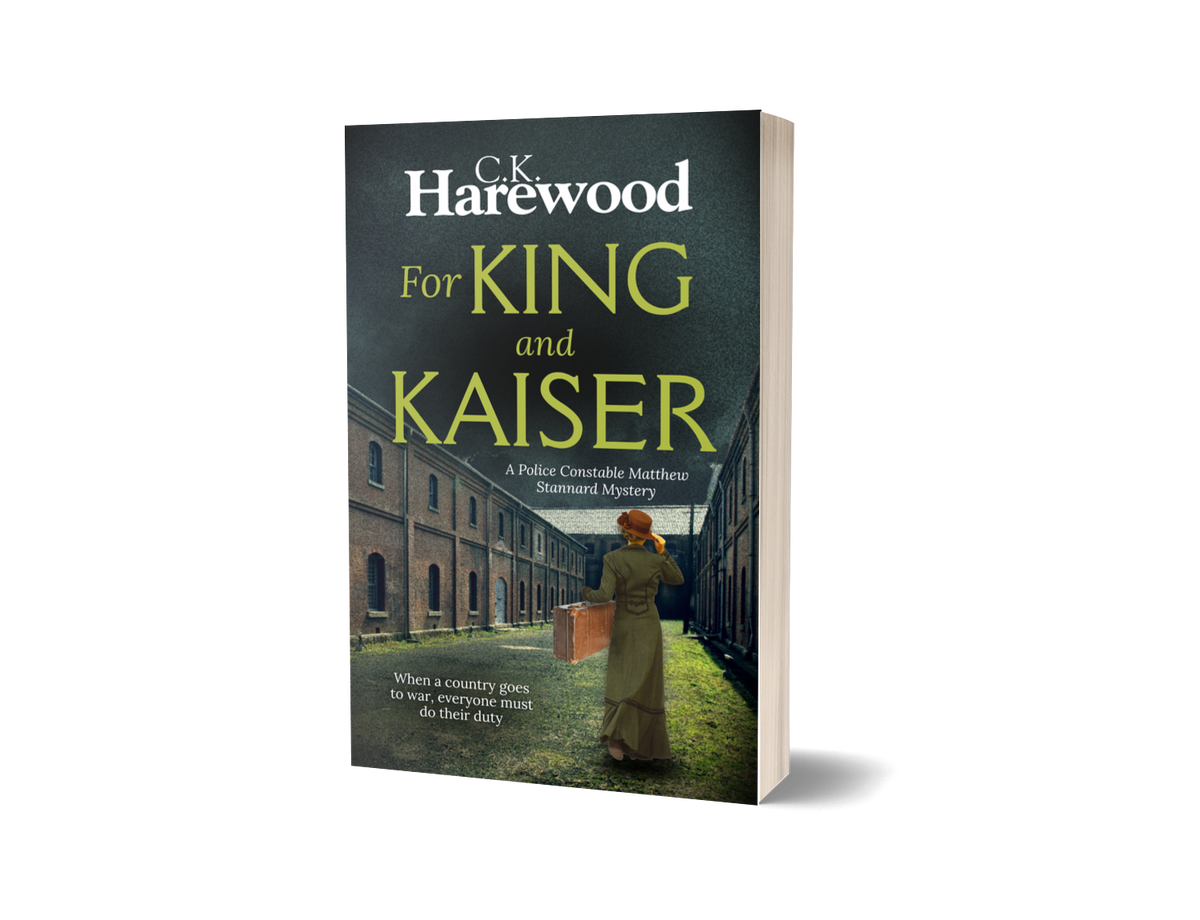
Book Details
| Author | C. K. Harewood |
|---|---|
| Series | Police Constable Matthew Stannard |
| Number in Series | 3 |
| Format | Paperback |
| Pages | 134 |
| ISBN | 978-191-2968-80-0 |
| Size | 5x8" |
| Language | English |
| Categories | Thriller & suspense, Crime & mystery, Historical fiction |
| Setting | 1914 England |
| Tone | Gritty, realistic |
| Other Formats | For King and Kaiser | eBook |